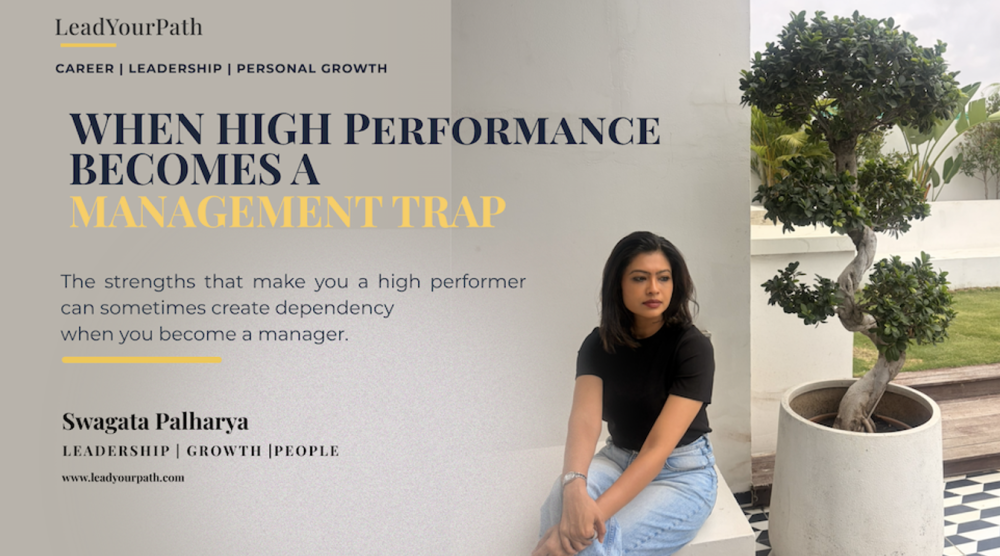
There was a point in my transition into leadership when I started noticing something I hadn't expected.
People were coming to me with problems earlier and earlier.
A team member would come to me with an issue, and quite often, I already knew what I would do.
So I would answer.
Sometimes it was a quick suggestion.
Sometimes I would explain how I had handled something similar.
Sometimes I would simply take the problem, solve it and move things forward.
And, honestly, it felt like good leadership.
I was being responsive. I was helping my team. I was removing roadblocks. Things were moving.
But after a while, I started noticing a pattern.
The problems weren't getting fewer. They were coming to me more often.
That made me pause.
Because the question I initially asked myself was:
Why does everyone keep coming to me?
But eventually, I realised there was another question I needed to ask:
Had I unintentionally become the fastest route to the answer?
That was uncomfortable to acknowledge.
Because the behaviours creating the dependency were the same behaviours that had helped me build my career.
I had spent years being the person who took ownership.
The person who responded quickly.
The person who solved problems.
The person who could be relied on when something needed to get done.
In client-facing roles, those qualities can be incredibly valuable. When a client needs an answer, the business is moving quickly, or the team needs a decision, there are moments when you simply need to step in and make things happen.
But becoming a manager changes something fundamental.
Your responsibility is no longer just your own output.
You are now responsible for creating an environment where other people can produce strong outcomes too.
And that's where some of the strengths that made you successful can start needing to be used differently.
I see versions of this now in my coaching conversations with first-time managers.
Someone will say:
"I don't understand why my team keeps coming to me for everything.”
And when we unpack what's happening, the manager is often doing exactly what has always worked for them.
They're being helpful.
They're being responsive.
They're giving answers.
They're getting things moving.
There is nothing wrong with any of those behaviours on their own.
The question is what happens when they become the default response to every problem.
Because if your team learns that bringing a problem to you is the quickest way to get an answer, they have very little reason to pause, think through the options and make the decision themselves.
That's where I started changing the way I helped.
Instead of immediately saying:
"Here's what I'd do…”
I would sometimes pause and ask:
"What have you tried so far?”
"What options are you considering?”
"What do you think we should do?”
Those questions don't mean stepping away from the team.
And they certainly don't mean turning every management conversation into a coaching conversation.
There are times when your team needs direction.
There are situations where you need to make the call.
There are deadlines, clients and business situations where you simply need to step in.
The shift is about becoming more intentional.
When do I need to solve this?
And:
When would it be more valuable to create space for someone else to solve it?
That's a subtle difference, but it can change the kind of team you build.
Because initially, it can actually feel slower.
Someone may take a different route from the one you would have taken.
They may need more time to think.
They may make a decision you wouldn't have made yourself.
But over time, something more important can happen.
Instead of:
"I have a problem. What should I do?”
you start hearing:
"Here are three options. I recommend this one because…”
That is a different kind of conversation.
The person hasn't just completed the task.
They have developed judgement.
They have practised decision-making.
They have started taking ownership.
And that, for me, is the real value of delegation and enabling.
The goal isn't simply to make yourself less busy.
It is to create more capability around you.
The real shift isn't from doing more to doing less.
It is from creating the result yourself to creating the conditions for others to create it.
So if you're a first-time manager, perhaps it's worth noticing one thing this week.
Think about something that keeps coming back to you.
A decision.
A client conversation.
A report.
A problem that seems to need your involvement every time.
And ask yourself:
Why am I still holding this?
Is it genuinely something only I can do?
Or am I holding it because:
"I can do it faster.”
"I know how to do it.”
"It's easier if I just do it myself.”
And perhaps the more important question is:
If I keep doing this, what capability might I be preventing someone else from developing?
Because leadership isn't about becoming the person with all the answers.
It is about creating a team that can find more of those answers without needing you to provide everyone.
And perhaps that's one of the hardest parts of becoming a leader:
learning that being needed is not always the same as being effective
If this article resonates with you and you'd like to explore it a little further, you can continue the conversation with Swagata here.