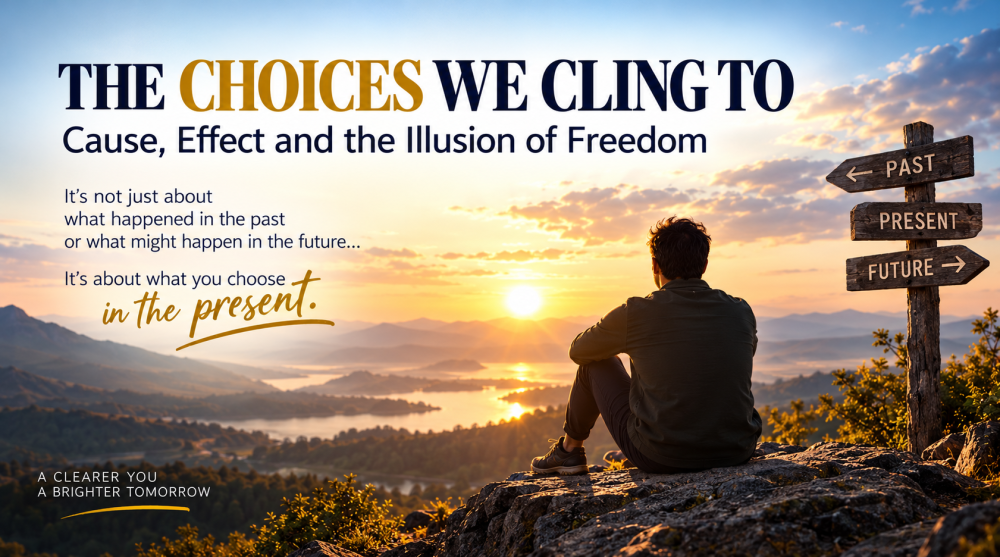
Cause, Effect and the Illusion of Freedom
A few years ago, I was having a conversation with a client who was going through a difficult phase in his career.
By conventional corporate standards, he was successful. Yet he was deeply unhappy with where he had ended up. Almost every conversation eventually returned to the same question:
"Why did this happen to me?”
He spoke about missed promotions, a boss who hadn't recognised his contribution, career decisions he wished he had made differently, and people who could have guided him when he needed it most.
There was one little word that kept appearing in our conversations: "IF.”
If only his boss had recognised his work. If only he had been promoted earlier. If only he had chosen a different career path.
His reasons were understandable. Some were probably justified, too. But the more he searched for the reasons behind his situation, the more powerless he seemed to feel in the present.
That conversation stayed with me because it raised a question I have often returned to: Can understanding why something happened sometimes become another reason we struggle to move forward?
Our present is undoubtedly shaped by our past. Understanding what happened can help us learn, make sense of difficult experiences and avoid repeating mistakes.
But there is a difference between learning from the past and becoming attached to it.
During one of our conversations, I asked my client:
"Suppose you discover the exact reason why you are where you are today. What will you do with that knowledge?”
There was silence.
After a long pause, he nodded. He was beginning to recognise that knowing the cause did not necessarily change the effect.
We often believe that understanding why something happened will free us from its consequences. Sometimes it does. But sometimes, all it gives us is a better explanation for why we are still where we are.
And that can become a trap of its own.
Perhaps you've experienced the opposite situation, too.
You are no longer looking backwards, trying to understand what went wrong. Instead, you are looking ahead, convinced that something needs to happen before life can feel better.
"When I get the promotion, I will be happy.”
"When I make enough money, I will feel secure.”
"When people recognise me, I will feel valued.”
"When this problem is solved, I will finally have peace.”
There is nothing wrong with wanting these things. Goals give us direction, and ambition can be a powerful force for change.
But when our happiness becomes entirely dependent on a future outcome, we risk overlooking the life we are living now.
We become attached to the effect.
And whether we cling to the cause or the effect, something similar happens: we lose sight of the present.
The past tells us why we cannot move forward. The future tells us what must happen before we can. Somewhere between the two, the present quietly slips away.
This brings me back to a thought I often reflect on:
Commit the Cause to Experience the Effect. Demit the Cause to Omit the Effect.
It may sound unusual, but the underlying idea is worth exploring.
Our actions have consequences. Some we can influence, others we cannot. We cannot rewrite every cause, nor can we guarantee every effect.
But that does not mean we are helpless.
We still have choices about how we respond to what has happened and what we do next.
This is where coaching becomes interesting to me.
A good coach cannot erase someone's past or promise a particular future. What coaching can do is help someone look at their situation differently, recognise the choices still available and decide what to do next.
And perhaps this is where the idea of the Guru also becomes relevant.
We sometimes imagine that a Guru, mentor or guide can free us from suffering, confusion or the patterns we keep repeating.
But can anyone truly free us from a choice we continue to make ourselves?
Someone may guide us. Someone may help us see what we have been missing. Someone may even show us a way forward.
But the choice remains ours.
Over time, I've come to believe that freedom is not necessarily about abandoning the cause or ignoring the effect.
It is about learning from the cause, responding to the effect and recognising when our attachment to either is preventing us from moving forward.
Understand the cause, but don't remain trapped in it.
Acknowledge the effect, but don't make your entire happiness dependent on it.
And return to the one place where you can still make a choice: the present.
Perhaps you recognise this in your own life. A decision you still regret. An opportunity you feel you missed. Or a future achievement you believe will finally make everything feel right.
What might change if, instead of asking only "Why did this happen to me?” or "What will happen if…?”, you asked yourself a different question?
"Given where I am now, what do I choose to do?”
Perhaps the Guru can show us the door. Perhaps the coach can help us see it.
But ultimately, we must choose whether to walk through it.