
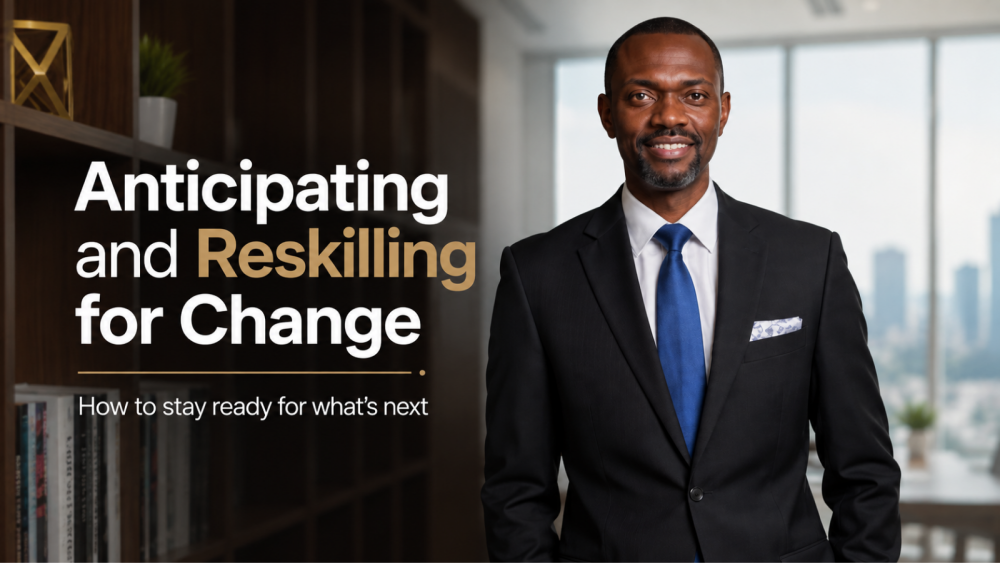
Earlier on in my career, I sat across from two of my directors who informed me that the organization was being restructured and my division was being "right sized”. In their words, "It isn’t an indictment on your performance as an individual but plainly a business call.” That exercise cost the division 60% of its workforce, and I was unfortunately one of them. That news broke me; the landing didn’t make the pain I felt go away.
That conversation has stayed with me because it captures what so many professionals feel in times of rapid change: pride in what they have built, uncertainty about what comes next, and a quiet fear of being left behind. In my work with leaders and professionals, I have learned that the people who navigate change best are not always the most confident at first. They are the ones willing to pause, notice what is shifting, and begin learning before urgency forces the decision.
That experience was just a momentary detour in my career and not a nail in its coffin. Beyond pharma sales, I leapfrogged into sales excellence and led the launch of a very successful mobile sales force automation project at a multinational a few years later.
Change isn’t theoretical anymore; it is the daily rhythm of modern work. Technology shifts overnight, industries reinvent themselves, and roles evolve faster than job titles can keep up. The professionals who thrive are not the ones who resist change; they are the ones who anticipate it and reskill early enough to stay ahead.
Coaching and mentoring make that possible by turning uncertainty into clarity and helping people build the confidence to navigate what’s next.
Why Anticipating Change Matters
Anticipation isn’t about predicting the future perfectly. It is about developing the awareness and agility to respond intelligently.
Another real-life example: A marketing manager from the MENA region of a partner organization noticed clients asking more questions about digital analytics. Rather than waiting for the trend to reshape her industry, she enrolled in a short data-literacy program and worked with a mentor to apply the skills to real campaigns.
Within six months, she became the go-to person for data-driven marketing in her company and earned a promotion during a restructuring that might otherwise have threatened her role. Change didn’t disrupt her career; anticipation strengthened it.
Reskilling: The New Professional Currency
Reskilling is no longer optional. It’s the fuel that keeps careers relevant and competitive.
Here’s what effective reskilling looks like today:
- Learn continuously. A project coordinator committed to one micro-course per month and, within a year, built capability in digital collaboration tools, agile methods, and AI-assisted workflows, enough to move into a hybrid project-operations role.
- Align skills with emerging trends. A customer service professional saw automation entering her workflow, reskilled in chatbot management and customer experience design, and now leads her company’s digital support transformation.
- Apply learning immediately. Instead of using AI only for entertainment, learn to use it to redesign a reporting process, reduce delivery time, and turn practical impact into visibility.
Reskilling isn’t about reacting to change; it’s about preparing for opportunity.
The Role of Coaching and Mentoring
Coaching and mentoring accelerate readiness by providing clarity, direction, and real-world insight.
Coaching helps you:
- Build adaptability and resilience
- Strengthen decision-making in uncertain environments
- Stay accountable to your growth goals
- Develop strategic thinking that anticipates future needs
Mentoring helps you:
- Learn from someone who has already navigated similar transitions
- Understand industry trends before they become mainstream
- Avoid common pitfalls during career shifts
- Expand your network into future-focused spaces
How to Start Anticipating and Reskilling Today
You don’t need a major career shift to begin. Small, intentional steps compound into big transformation.
- Scan your industry regularly through newsletters, webinars, and thought leaders.
- Identify skills that will matter in two to five years, not just today.
- Seek feedback often to uncover blind spots.
- Invest in micro-learning through short courses, podcasts, and coaching sessions.
- Work with a coach or mentor to accelerate clarity and confidence.
- Experiment with new tools and cross-functional projects.
Anticipation is a habit. Reskilling is a commitment. Both are within your control.
The Future Belongs to the Prepared
Change can feel overwhelming, but with the right mindset, skills, and support system, it becomes a catalyst for growth rather than a source of anxiety.
Perhaps the real question is not whether change will come, but who we choose to become before it arrives.
When we anticipate, learn, and stay open to reinvention, change stops being a threat waiting at the door and becomes an invitation to grow into the next version of our work, our leadership, and ourselves.
Change starts with one conversation. Let’s continue here.