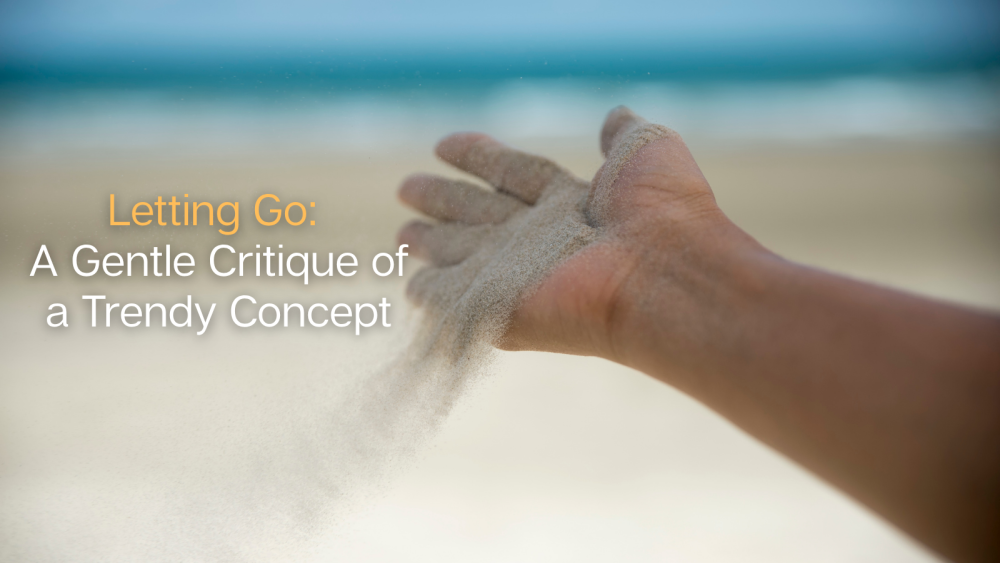
"Letting Go!” is a very popular idea found in many personal development books.
Throughout the pages, we read about the benefits of this vaguely defined concept, and we find abundant recommendations on how to achieve it. This literature particularly appeals to us when we are experiencing uncomfortable, unpleasant situations, and we feel that life is hard. When we are overwhelmed with work at the office, when the mental burden at home leaves no space for relaxation, when we have had enough of our teenager and their video games. It is in these situations where our ability to accept things is put to the test and our threshold for tolerance is reached, that the need to let go becomes most pressing.
In these instances, close friends, family members and colleagues, concerned about our well-being, often give us this precious advice: "You must let go,” "but let go, for God’s sake, you’ll see, everything will be much better after”… Sometimes, when faced with a personal problem, when we feel we have tried everything, when mental and physical exhaustion incapacitates us, when our own complaints about our miserable situation are heard too frequently, we say to ourselves, a little out of desperation: "I have to let go”. I need to stop being so uptight and let go of the grip.
Whether they come from those around us or from ourselves, these well-intentioned injunctions are perfectly ineffective, given their paradoxical nature: letting go is not a voluntary decision. It is even the opposite; it can only happen when the will fades away. But in the end, why should we let go? What if "holding on” had its advantages?
My 13-year-old son is passionate about climbing. He trains in a climbing gym several times a week and has earned several certifications. His idol? Alex Honnold. You know who he is? He is this incredible athlete, able to climb the most dizzying walls, with his bare hands, without any equipment, free solo. In June 2017, he accomplished the completely crazy feat of climbing El Capitan, a 900-meter-high vertical rock formation located in Yosemite National Park, in the United States, in just 3 hours and 56 minutes. It’s enough to make you dizzy, isn’t it? Would you let go, alone facing the wall, with the void below you?
Why this metaphor? Simply because it allows us to approach the theme of letting go from a different angle.
Climbing is a demanding sport: a large part of the visual preparation gives way to the unknown, the unpredictable. You find yourself alone facing a wall whose roughness and difficulty are not entirely known. This requires a solid mental state, great confidence in your abilities… and a good dose of humility: you must know when to stop and sometimes even retreat. Holding on to the grip is, of course, necessary to avoid falling. But staying attached to it would be pointless and could be just as dangerous. The ascent is made possible through alternation of these two actions, "taking hold” and "letting go.”
To continue the metaphor, ascending means, in an environment that presents its share of difficulties and dangers but also offers some resources, chaining the art of taking hold and letting go.
Climbing can be compared to the yin-yang alternation. With a yin movement, letting go of a grip to look for the next one, test it, choose it (or eliminate it), succeeds a yang movement, where you firmly hold on to the grip to raise yourself one step higher. Understood in this sense, letting go is not only a matter of releasing a tension, but rather of smoothly transitioning from a grip to a release, and then to a new grip, and so on.
The example of climbing also allows us to illustrate that letting go is not a matter of linear logic where one reaches a goal by following a plan, step by step. It would certainly be tempting to yield to this logic: focused on his route strategy, controlling every movement perfectly, moving from one grip to another, striving towards his conscious goal of reaching the summit. But if we really think about it, our climber follows a circular logic. He communicates with the wall. He may even feel a form of intimacy with it. For it gives him all sorts of information: here it slips, here it’s crumbly, here it’s too far, here it holds…. He makes his decisions based on this information. There is indeed a feedback loop.
From this communication with the wall, and more broadly with the environment in which he moves, a variety of emotions emerge in our climber: perhaps fear when a grip proves insecure, relief when he has just crossed an overhang, or the pleasure of feeling his muscles contracting and relaxing, being one with the rock. These emotions are responses to the intimate talk with the wall. Our climber has every interest in taking them into account. Perhaps it is even the quest for this emotional thrill that constitutes his true goal…What allows the climber to stay balanced on his wall is a combination of all this: the alternation of "taking hold” and "letting go,” communication with the environment, and listening to his emotions.
If we apply this metaphor to our daily lives, we can see the source of the problems mentioned at the beginning of this article, for which we invoke letting go. They stem from an imbalance between these different factors. The yin-yang alternation is broken.
We cling to a situation that we should let go of, sometimes because we cannot find a sufficient grip. The emotions that this creates can be painful, distressing: we are afraid, we feel anxiety or anguish, or we get angry. We might even fall into sadness or depression. We then come to fight against our emotions, which amounts to cutting ourselves off from the situation that provokes them. No improvement can be expected through this method, since it prevents the necessary regulations… Then it is the body that speaks. To make things worse, we are not listening to the signals it sends us. We are desensitized, not hearing, not seeing, ‘non-perceiving.’ We let ourselves be overwhelmed by our reflective mental activity, and we say to ourselves "I must let go”…
The solution to get out of this vicious circle is to look for the opposite movement of the one that led us there. That is, to rehabilitate the feeling, give emotion its rightful place, recognize its legitimacy and even its usefulness: it informs us about the situation to be changed. The struggle between emotions, which try to express themselves, and the mind, which tries to control them, can then be appeased. The emotional reaction becomes less intense, the mind calms down. We are in a better position to deal with the problem situation. It is by evaluating its dangers and the resources at our disposal, both in ourselves and in the external environment, that we can find the movement that will get us out of it, and restore the yin-yang balance, the dynamics of life. Perhaps then, the need to let go will no longer be so pressing…
Let's continue this conversation, get in touch here.
This article was based on an original idea by Marie-Laure Sinimale, with Dany Gerbinet’s generous contribution. You are reading a translation from French.