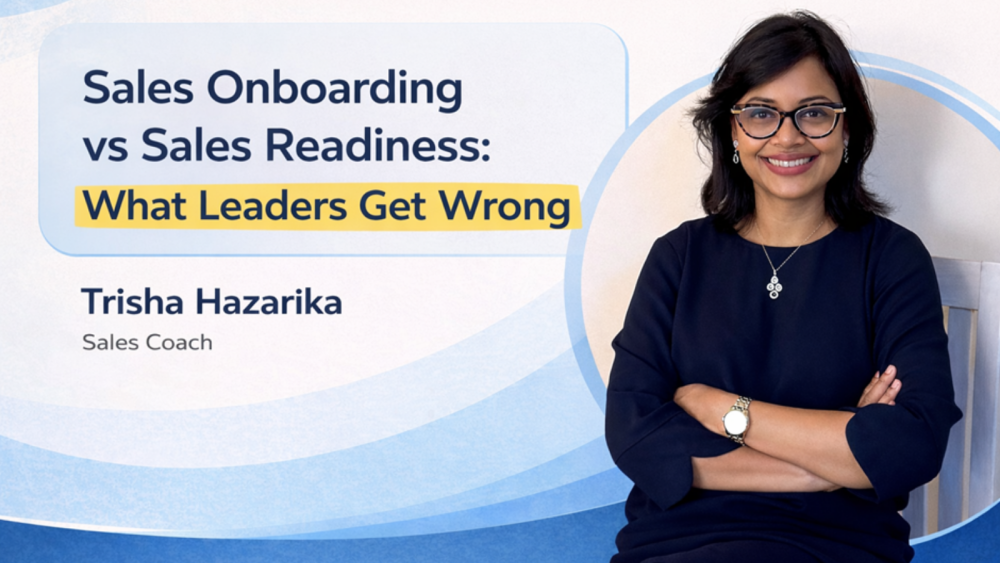
There’s a pattern I see again and again in growing sales teams.
A new joiner walks through the door. Smart. Confident. Strong CV. Impressive past numbers. By Day Three, they are already speaking to prospects. It feels efficient. It looks proactive. It signals momentum.
But often, it is expensive.
Because onboarding and readiness are not the same thing. Confusing the two quietly chips away at performance. Most companies define "ready” in operational terms: product training completed, CRM access granted, pricing sheets shared, laptops loaded with every AI tool under the sun. That is onboarding.
Readiness is something else entirely.
Readiness is when a new hire understands how your company sells. Not just what you sell. It is when they can position your brand without sounding generic, explain why you win and why you deserve to win without defaulting to discounting, and sit in front of a decision maker with confidence, holding their ground even under pushback. It is when they know what good looks like in your pipeline, not in theory, but in action.
If your assumption is "they will learn on the job,” what you are really saying is we are comfortable with ambiguity. And ambiguity is where confidence collapses.
I strongly believe new joiners should be certified before they hit the sales floor. They should know in their gut that your product or service actually solves a problem. Not in a bureaucratic, checkbox way but in a performance way. Certification should answer one question. Would I trust this person alone in front of my biggest prospect? If there is hesitation, they are not ready.
True readiness is not just knowledge. It is decision making under real pressure. Can they articulate your sales process and move a deal forward without guessing? Do they understand what stalls deals in your environment? Can they handle competitor comparisons without escalating internally? Can they respond to "Just send me an email” without retreating? And just as importantly, do they understand your culture, your escalation process, your standards?
This is not training. It is qualification.
I once worked with a new hire who came in with an impressive track record. Most organizations would have thrown her onto the sales floor immediately. We did not. Instead, we introduced a structured two-week certification framework before she engaged any prospects independently.
During those two weeks, she practiced simulated decision maker conversations, objection handling under pressure, competitive positioning drills, CRM stage testing, and structured feedback sessions. Nothing went live until she demonstrated clarity in process, authority in conversations, and discipline in follow-ups. She was not protected. She was prepared, equipped with cultural intelligence tailored for the GCC market.
The results in her first 90 days were measurable. Her conversion rate was 28 percent higher than the team average. Her sales cycle was 17 percent shorter. Zero escalations due to mishandled objections. Pipeline hygiene at 95 percent. But the most important result was not in the dashboard. She never experienced the Month Two confidence dip that so many new joiners face. She did not start strong only to quietly unravel. She entered the floor without ambiguity. She was not guessing. She was operating.
When new joiners fail, leaders often conclude they were not the right fit. Sometimes that is true. But more often, they were simply underprepared for your specific selling environment. Early struggles erode confidence. Defensive behavior creeps in. Activity increases, but quality drops. Managers start micromanaging. Culture tightens. All because structure was skipped in the name of speed.
Without certification, ramp time stretches. Managerial intervention rises. Revenue becomes volatile. Attrition climbs. And perhaps most dangerously, you signal to your team that speed matters more than standards.
Strong sales leaders do not just onboard people. They qualify them. They define observable readiness criteria, build psychological safety through simulations, and remove ambiguity before high-stakes conversations. Sending someone unprepared to a decision maker is not empowerment. It is exposure. And exposure without structure damages confidence in ways that are hard to reverse.
If you are scaling a sales team, ask yourself this. Are you deploying people? Or are you certifying them? There is a difference, and that difference shows up in your numbers.
I am a Sales Coach and Consultant based in Dubai, working with clients across the GCC to ensure their Sales Onboarding is structured, leak-proof, and guaranteed. Retention is the new recruitment strategy. Book a call with me on Mentaa to chat about how we can collaborate.