There are moments in leadership that stay with you, not because a decision was made or because a strategy changed, but because someone asked a question that quietly shifted the way you looked at the world.
I had one of those moments recently during a conversation with a group of senior executives. We had spent the better part of an hour discussing artificial intelligence, exploring the latest tools, debating productivity gains, and imagining how rapidly the workplace was about to evolve. It was the kind of discussion happening in boardrooms everywhere, full of optimism, healthy skepticism, and an unmistakable sense that we were standing at the beginning of something significant.
Then someone broke the flow of the conversation with a simple question.
"If AI can increasingly perform the work, what exactly becomes the responsibility of HR?"
Nobody rushed to answer.
It wasn't because the room lacked expertise. Quite the opposite. The silence came from the realization that the question wasn't really about Human Resources at all. It was about the future of organizations.
In that moment, I found myself thinking less about technology and more about the people who would have to live with its consequences. I realized that while we spend an extraordinary amount of time asking what AI is capable of doing, we spend far less time asking what kind of organizations we are trying to build because of it.
That distinction matters more than I think we appreciate.
For years, digital transformation has largely been framed as a technology challenge. Organizations invested in new platforms, modernized infrastructure, digitized processes, and measured success by implementation milestones and efficiency gains. Yet anyone who has led a transformation programme knows that technology has never been the hardest part. The real work has always begun after the software was installed, when people were asked to think differently, collaborate differently, and often redefine their own role in the organization. Technology simply created the possibility for change. People determined whether that possibility became reality.
Artificial intelligence is no different, although its impact reaches much further.
Unlike previous waves of technology, AI does not simply make existing processes faster or cheaper. It fundamentally changes the relationship between people and work. Knowledge, once considered one of the most valuable individual assets within an organization, is becoming increasingly accessible. Tasks that once demanded years of experience can now be completed in minutes. Decision-making is becoming augmented, creativity is being accelerated, and routine cognitive work is steadily being delegated to intelligent systems.
Perhaps you've already noticed this shift in your own organization. Conversations that once centered on software, systems, and implementation are increasingly becoming conversations about trust, judgment, governance, and leadership. The technology may be new, but the real challenge remains remarkably familiar: helping people navigate change.
As this happens, the questions facing leadership become less technical and profoundly more human.
Suddenly, the conversation is no longer about which platform to purchase or which model to deploy. Instead, leaders are confronted with questions that are considerably more difficult to answer. Which responsibilities should always remain human? How do we preserve judgment, empathy, and accountability when intelligent systems become active participants in decision-making? What skills will define leadership when access to information is no longer a competitive advantage? How do we redesign careers, learning, and performance in an environment where the very nature of work is constantly shifting?
These are not questions that belong exclusively to the CIO or the technology team. They are questions about organizational design, culture, governance, and leadership. They demand a different kind of conversation, one that reaches across every function of the business.
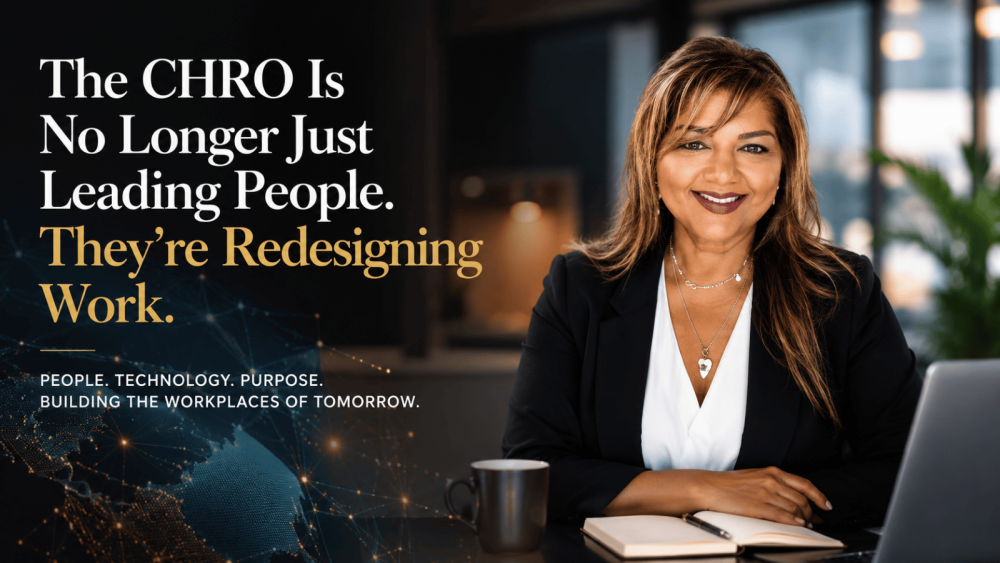
Yet if there is one executive uniquely positioned to help guide that conversation, I believe it is the CHRO.
Not because HR suddenly owns artificial intelligence, but because every successful AI transformation eventually becomes a human transformation.
Perhaps that's why the question has stayed with me long after the meeting ended. It sounded, on the surface, like a question about Human Resources, but I don't believe it was. I think it was really a question about leadership, about the kind of organizations we want to build, and about whether we are prepared to redesign work instead of simply automating it.
After more than two decades leading technology, people, and operational transformation, I've come to believe that the most meaningful change never begins with software. It begins with a leadership team willing to challenge long-held assumptions about how work gets done and courageous enough to redesign the organization around a better future.
I didn't always see it that way.
Early in my career, I was just as fascinated by the technology itself. Like many leaders, I believed that choosing the right platform or implementing the right solution was where transformation began. Experience taught me otherwise. Project after project reinforced the same lesson: technology can enable change, but it never creates it on its own. People do. That shift in perspective has fundamentally changed the way I approach every transformation programme today.
Perhaps that's also why I find myself so drawn to these conversations. Throughout my career, I've rarely sat entirely in one world or the other. I've led IT organizations, served as Chief People Officer, and worked across operations and business transformation. Those experiences have given me a perspective that few leaders have the opportunity to develop.
I don't see technology and people as separate conversations. I see them as two sides of the same transformation.
Today, I often describe myself as someone who sits at the intersection of technology and HR, where innovation meets human potential, where digital capability meets organizational design, and where strategy ultimately succeeds or fails because of people. It's an interesting place to stand, because you quickly realize that artificial intelligence isn't simply changing technology.
It's changing leadership itself.
The organizations that will thrive over the next decade won't necessarily be those with the most advanced AI or the largest technology budgets. They'll be the ones whose leaders understand how to bring people, technology, governance, and culture together into a single, coherent vision.
So perhaps the real question isn't whether AI will change the way we work. It already is. The more important question is whether we're willing to rethink what leadership looks like in response.
That's a conversation I believe every leadership team should already be having. And perhaps it's one worth continuing in your own organization.
Let's continue this conversation here.