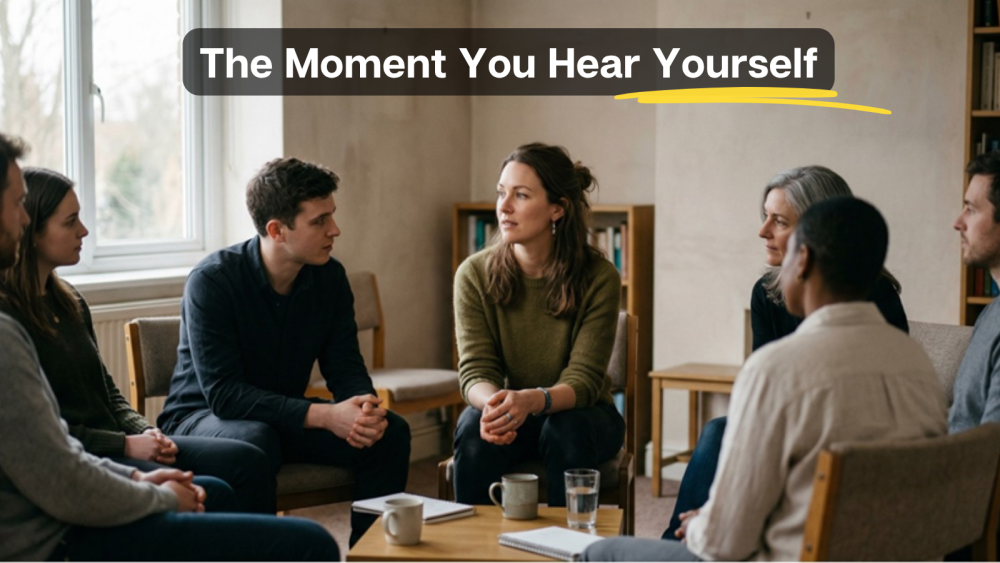
There's a moment I keep thinking about from a group session a few weeks ago.
A man, confident, self-aware, clearly someone who had done some inner work, told the group that he stays calm under pressure. Not defensively. He said it the way you'd say any fact about yourself. He said it the way you’d state a simple fact about yourself.
The group sat with it for a moment. Then someone asked him, gently, how he actually behaves when things go sideways at work. Not what he feels inside, what do people around him see?
That's when something shifted.
He started talking faster. His sentences got longer. He began explaining his calmness in detail, giving examples, citing situations, building a case. The more the group stayed quietly curious, the more he elaborated. At some point, he was practically presenting evidence.
And then he stopped.
He looked around the room, and said, almost to himself:
"I think I'm trying to convince you that I'm calm."
The room got very still.
That moment, that small, honest pause, is what resilience work is actually about, in my experience. Not techniques. Not breathing exercises. Not reframing tools. It's the moment when you catch yourself doing the thing, while you're doing it.
Most of us carry a story about who we are under pressure. It's not a lie exactly. It's more like a self-portrait painted in the good light, during the good days. We genuinely believe it, because we've told it enough times and nobody has handed us a mirror at the right moment.
Pressure speeds things up. The gap between what we feel and what we do becomes very small. And in that narrow space, old patterns come out, not the ones we've polished for interviews or therapy sessions, but the ones that were there long before we had words for them.
Some people go quiet. Some go loud. Some become hyper-competent and controlling. Some start apologising before anyone has accused them of anything. Some, like the man in that session, start building a courtroom case for their own composure.
None of these are character flaws. They're just patterns. Most of them made sense once, in some earlier version of our lives. They were useful then. They got us through something. The trouble is, they keep showing up whether we need them or not, whether we've invited them or not.
The harder thing to sit with is this: you usually can't see these patterns from the inside. Not while they're running. That's not because you're not smart or self-aware. It's because when you're under pressure, your attention is on the external situation, the problem, the person, the deadline, not on what your hands are doing or how fast you're talking.
That's why other people often know our pressure-patterns before we do. A spouse, a close colleague, a sibling. They've watched us across enough difficult moments to recognise the shape of it. We get a certain look. Or we say a particular phrase every time. Or we suddenly become extremely interested in solving a problem that doesn't actually need solving in that moment.
We don't notice it. They do.
In a group setting, that awareness becomes a kind of gift, because nobody is close enough to have an agenda, and nobody is far enough to be indifferent. When someone says, quietly,I noticed you started speaking much faster just now, there's no threat in it. Just an observation. And sometimes that's all it takes.
The man in the session didn't need anyone to tell him what his pattern meant or where it came from. He just needed enough stillness around him to hear himself. That was the whole thing.
He laughed a little after he said it. The kind of laugh that comes when something lands cleanly, when recognition arrives without the weight of shame. He sat back. The room breathed again.
He didn't suddenly become a different person. Nobody does. But he left that session knowing something about himself that he hadn't walked in with. Not as a concept, as a lived moment.
That's a different kind of knowing.
When was the last time you noticed yourself trying to prove something about who you are under pressure?
Every transformation starts with a single conversation, let’s talk.