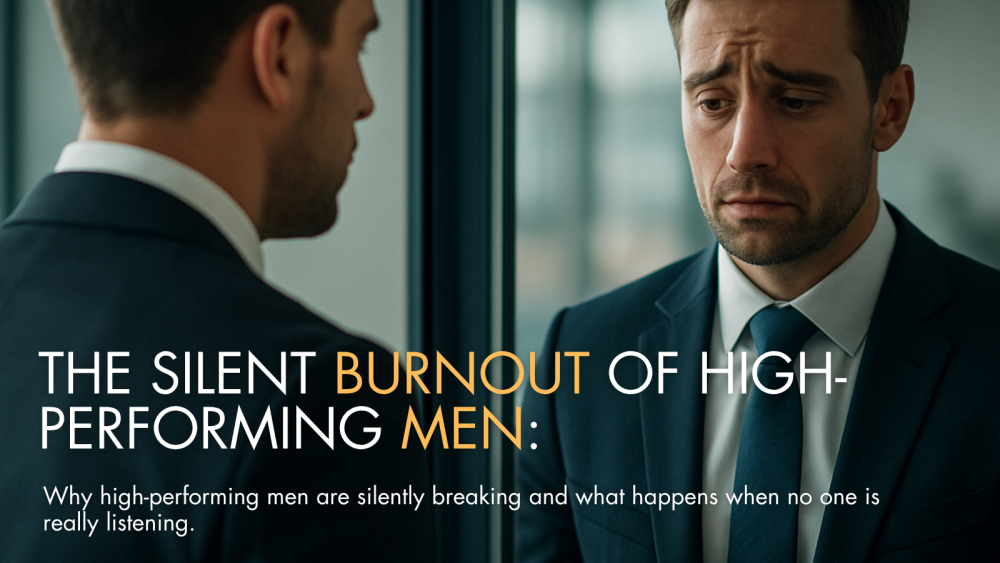
He arrived five minutes early, as if punctuality could still prove something.
There was a certain precision to him, the kind you don’t notice at first until you sit across from it. His back remained straight even when he relaxed into the chair. His hands rested neatly, almost deliberately, on his knees. When he spoke, every sentence felt pre-constructed, filtered, safe. You could tell he had spent years in rooms where words were currency and mistakes were expensive.
If you didn’t know better, you would think he was fine.
Fifteen years in a senior leadership role had taught him how to carry himself. Six months ago, that role had vanished. Not dramatically, not with conflict or noise, but quietly—dissolved in a restructuring that came packaged in polite language and a calendar invite that lasted less than half an hour. Just like that, something he had built over more than a decade no longer existed.
He never called it a loss.
He referred to it, carefully, as "a transition.”
There is something about that word, how it softens the edges of what is actually happening. It allows you to move forward without fully acknowledging what has been left behind. For men like him, that matters. Language is often the only place where emotion is permitted, and even there, it must be controlled.
We began, as expected, with the surface.
He spoke about work, or what remained of it. About how objectives seemed to shift overnight without warning. How meetings appeared at impossible hours, as if sleep had become optional in a globalized world that never really stopped. He described conversations where language subtly changed, just enough to leave him slightly outside of understanding, never quite certain if he was missing something or if something was being withheld. There were too many projects, too many expectations, too many moments where accountability landed squarely on his shoulders for things he did not own.
He said all of this without frustration.
That was the first signal.
Because when something truly affects you, it rarely comes out clean. It leaks. It stumbles. It resists being packaged into tidy sentences. But he had mastered that too, how to present difficulty without revealing its weight.
It wasn’t what he said that stayed with me. It was what sat quietly underneath it.
The brief tightening of his jaw when he mentioned being publicly undermined. The almost imperceptible pause before he insisted, "It’s manageable.” The way his eyes shifted, just for a second, when he spoke about not fully understanding what was expected of him anymore.
There is a kind of pressure that does not announce itself. It does not shout or break things in obvious ways. Instead, it accumulates, layer by layer, until the person carrying it can no longer distinguish where the pressure ends and they begin.
This is the pressure we rarely name. Not because it isn’t real, but because it does not fit the narratives we are comfortable telling.
For men, especially, there is an additional layer to this silence. Many have been raised, implicitly or explicitly, to believe that their role is to provide, to protect, to endure. To be the stable point in a world that is anything but. And stability, in this context, often means silence.
You adapt.
You take on more. You work harder. You convince yourself that if you can just hold everything together a little longer, it will eventually settle.
And when it doesn’t, you adjust again.
Until one day, the effort of holding it all together becomes heavier than the things you are holding.
At some point in our conversation, I asked him a question that seemed simple enough.
"What is actually bothering you?”
He smiled, politely at first, the way people do when they are buying time. It was a familiar expression, one that had likely served him well in countless meetings and negotiations. But this time, there was nowhere to direct it. No audience to persuade, no outcome to manage.
The silence that followed was different from the ones before. It was longer, less controlled. You could almost feel the internal negotiation happening in real time, the part of him that wanted to maintain composure and the part that was, perhaps for the first time in a while, considering honesty.
When he finally spoke, his voice had changed.
"I don’t think anyone really sees what I’m carrying.”
It was not a dramatic statement. He did not raise his voice or lose control. If anything, it came out quietly, almost as if he was testing whether the words were allowed to exist outside of his own head.
But it shifted everything.
Because suddenly, the long list of operational frustrations, the meetings, the shifting priorities, the unclear expectations, fell into place around something much more fundamental.
Invisibility.
From the outside, his life held all the markers of success. A strong career, years of progression, financial stability, a family that depended on him. By most definitions, he had done everything right.
And yet, sitting across from me, there was a sense of emptiness that none of those things had managed to fill.
This is the paradox that so many people find themselves living inside.
The golden cage.
A life that looks complete from the outside, but feels strangely hollow from within. A quiet disconnection between what has been achieved and what is actually felt. And perhaps most disorienting of all, no clear language to explain why.
For many men, this dissonance remains unspoken.
Not because it is not felt, but because there has been little space to practice expressing it. Over time, the inability to articulate these experiences does not make them disappear. It simply redirects them.
It is not that help is unavailable.
In fact, more people than ever are seeking it. Across all ages, all levels, all industries, the demand for support has grown beyond the capacity of those trained to provide it.
And yet, within many organizations, mental health continues to be treated as secondary. A consideration, rather than a priority. A cost, rather than an investment.
There is a quiet assumption that performance can be maintained independently of the person producing it. But the two have never been separate.
What we ask of people—mentally, emotionally, psychologically—inevitably shapes what they are able to give in return.
The challenge is not a lack of awareness. Conversations about mental health have become more visible, more accepted, more frequent. Slogans encourage us to see, to say, to sort.
But recognition alone does not create change. Something deeper is required.
As the conversation continued, there was a gradual shift in him. It did not happen all at once, and it was not dramatic. His posture softened slightly. The precision in his language loosened. He began to speak less like someone presenting information and more like someone trying to understand his own experience as he described it.
Nothing external had changed.
The same pressures existed. The same uncertainties remained.
But internally, something had begun to move.
He was no longer carrying it alone.
That, more than anything, is where resilience begins.
Not in the ability to endure endlessly, but in the ability to process what is being endured. To recognize it, to name it, to allow it to exist without immediately trying to suppress or solve it.
And perhaps most importantly, to do so in the presence of another human being.
Because despite the increasing role of technology in our lives, there are certain things it cannot replicate. It cannot offer presence in the way another person can. It cannot sense hesitation, or notice the shift in tone that reveals more than words ever could. It cannot create the kind of connection through which people regulate, understand, and ultimately find some form of peace.
We do not resolve ourselves in isolation. We do it in relationship.
Before he left, he paused. It was a small moment, easily missed if you were not paying attention. He stood still slightly, as if reconsidering whether to say something more.
"I didn’t realize how much I needed this,” he said.
There was no performance in his voice now. No need to manage how it sounded.
Just truth.
And in that moment, it became clear that the question is not whether people are struggling. Many are. Quietly, consistently, often invisibly.
The real question is whether we are creating environments, in our workplaces, in our leadership, in our conversations, where it is safe enough for them to stop pretending that they are not.
Because strength was never meant to be measured by how much someone can carry alone.
And perhaps, if we begin to understand that, fewer people will feel the need to.
Feeling alone, isolated or that no one understands you, get in touch today, it takes one conversation to open a world of possibilities.